Real epoxy application data from 500+ NCR installs.
Last updated 03 October 2026. These are field results from residential and industrial epoxy applications across Ghaziabad, Delhi, Noida, Gurgaon and Faridabad — pot life by temperature, humidity failure rates, city curing charts, coverage, mix ratios and price history. Not manufacturer spec sheets.
Monsoon is where epoxy dies
Based on 318 documented indoor installations across Ghaziabad, Delhi, Noida, Gurgaon and Faridabad (2019–2026). Failure means a surface defect requiring sanding and a re-pour.
| Relative Humidity | Clear Cast | Flowtop | Silcrete | ClearLam CC | Lapox Ultra |
|---|---|---|---|---|---|
| <60% | <1% failure | <2% failure | <1% failure | <1% failure | <1% failure |
| 60–80% | 5% failure | 8% failure | 3% failure | 6% failure | 4% failure |
| 80–90% | 35% failure | 40% failure | 22% failure | 30% failure | 28% failure |
| >90% | 65% failure | 70% failure | 50% failure | 60% failure | 55% failure |
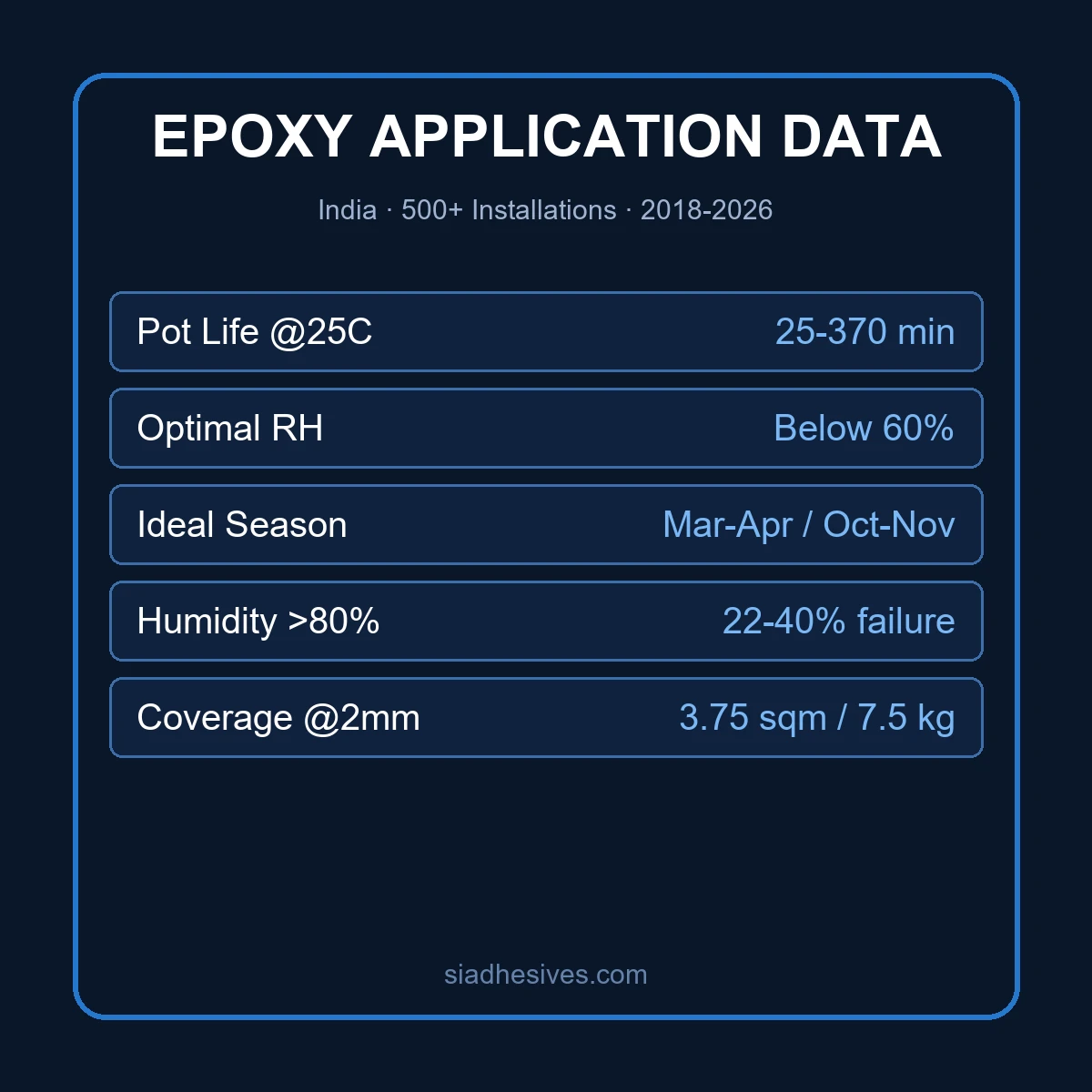
Key finding: Humidity above 80% causes catastrophic failure across all products. Run a dehumidifier during the NCR monsoon (July–September). The ₹15,000 cloudy epoxy failure in our fix guide happened at 91% relative humidity.
How far one pack actually goes
Measured coverage from field applications. Actual yield varies with surface porosity and applied thickness.
| Product | Pack Size | Coverage Per Pack | Recommended Thickness | Yield At 2mm |
|---|---|---|---|---|
| Bondone Clear Cast | 1.2kg | 0.3–0.5 sqm | 5–25mm (deep pour) | N/A |
| Bondone Clear Cast | 12kg | 3–5 sqm | 5–25mm (deep pour) | N/A |
| Bondone Flowtop | 7.5kg | 4–6 sqm | 1.5–2mm | 3.75 sqm |
| Bondone Silcrete | 7.5kg | 5–8 sqm | 0.5–1mm (primer coat) | N/A |
| Bondone ClearLam CC | 1.5kg | 0.8–1.2 sqm | 1–2mm (lamination/thin coat) | 0.75 sqm |
| Lapox Ultra | 1.8kg | 0.5–1 sqm | 2–5mm | 0.9 sqm |
How long until it's fully cured
Full cure times at 25°C and 50% RH. Higher temperatures shorten cure; lower temperatures extend it significantly.
| Product | Touch Dry | Light Traffic | Full Cure | Food Safe (Clear Cast) |
|---|---|---|---|---|
| Bondone Clear Cast | 8–12 hrs | 24 hrs | 7 days | 14 days |
| Bondone Flowtop | 4–6 hrs | 24 hrs | 5–7 days | N/A |
| Bondone Silcrete | 2–4 hrs | 12 hrs | 3–5 days | N/A |
| Bondone ClearLam CC | 2–3 hrs | 12 hrs | 3–5 days | 7 days |
| Lapox Ultra | 4–6 hrs | 24 hrs | 5–7 days | N/A |
| Bondone Cleartite | 4–5 hrs | 8–9 hrs | 24 hrs (bond strength) | N/A |
| Bondone Bristle Grip A | 2–3 hrs | 10–12 hrs | 24 hrs (bond strength) | N/A |
| Wacker Elastosil M 4511 | 8–10 hrs (tack-free) | 8–10 hrs (demold) | 4 days at 23°C | N/A |
| Loctite 243 | Fixture 5 min (steel) | 10 min (aluminium), 15 min (passive metals) | 24 hrs | N/A |
| Loctite 406 | Fixture <5 sec (most plastics) | 20–45 sec (steel), 10–20 sec (polycarbonate) | 24–72 hrs | N/A |
Eight years of NCR installs
| Metric | Count | Details |
|---|---|---|
| Total installations | 500+ | Residential, commercial, industrial across NCR |
| River table projects | 50+ | Resin for tables across India — Gurgaon farmhouse to Pune apartment |
| Product lines distributed | 4 | Bondone, Lapox, Jubitite, Lapox Metalam, Wacker |
| Years in operation | 8+ | Founded by Jobin Samuel, Ghaziabad |
| Cities served | 10+ | Delhi, Ghaziabad, Noida, Gurgaon, Faridabad + PAN India delivery |
Real story: One call I still remember — in July 2024 a contractor in Noida poured 9 m² of Flowtop during a week of 85% RH and it stayed tacky for six days. I told him to strip it and wait for October. We shipped a dehumidifier with the replacement kit, and that floor has cured hard for two years since.
Which resin fits your pour
Match the result you need to the product, based on the field data above.
| If you want to | Use | Why |
|---|---|---|
| Deep-pour casting (5–25mm) | Bondone Clear Cast | 3:1 ratio, 370-min pot life at 25°C |
| Self-levelling floor coat | Bondone Flowtop | 4–6 sqm per 7.5kg pack, 60–75 min pot life |
| Primer or sealer coat | Bondone Silcrete | 0.5–1mm primer, chemical-resistant film |
| Lamination / thin coating | Bondone ClearLam CC | 0.8–1.2 sqm per 1.5kg, self-levelling |
| Fast structural bond | Bondone Cleartite | Full bond strength in 24 hrs |
| Threadlocking metal fasteners | Loctite 243 | One-part anaerobic — cures without air between close-fitting metal surfaces |
| Bond plastics or rubbers in seconds | Loctite 406 | One-part cyanoacrylate — fixtures in under 5 sec, no mixing |
| Flexible silicone molds for casting | Wacker Elastosil M 4511 | RTV-2 silicone — Shore A 12, pot life 60–90 min at 23°C |
Shelf life, storage rules and warning signs for Indian conditions
Heat, humidity and monsoon moisture decide how long your resin and hardener stay usable. Get storage wrong and a premium kit can fail before you open the lid. As of October 2026, these are the shelf life numbers printed on every kit we ship from Ghaziabad.
| Component | Unopened Shelf Life | Opened Shelf Life | Storage Risk |
|---|---|---|---|
| Epoxy Resin (Part A) | 2+ years | 12 months | Low — crystallisation in cold |
| Hardener (Part B) | 2 years | 6 months | High — moisture, heat degrade it |
| Mixed epoxy | — | Pot life only (minutes) | Cannot be stored |
Key insight: Hardener is the shelf-life bottleneck. If a kit sits unused for a year, the hardener — not the resin — decides whether it is still usable. Hardeners always degrade faster; moisture and heat are the enemies.
Signs your epoxy has gone bad
Cloudy or milky hardener
Moisture contamination. Do not use it — it will never cure properly.
Dark brown hardener
Normal aging if it was light amber. Test on a small batch before the real pour.
Solid chunks in hardener
The hardener has expired. Discard the whole kit.
Resin crystallisation
Solid, wax-like resin is reversible — warm to 30°C in a water bath and stir until clear.
Separation in resin
An oil-like layer on top. Stir thoroughly; if it will not remix, discard it.
Ammonia smell
A strong ammonia odour from the hardener means it has degraded beyond use.
Thick, honey-like hardener
Evaporation or moisture absorption. If it is hard to pour, discard it.
Six storage rules for Indian conditions
Store below 30°C
Keep kits in an air-conditioned room or the coolest corner of the workshop.
Seal airtight after opening
Squeeze the air out of the hardener bottle before you reseal it.
Add silica gel packs
Drop one into the storage box to absorb moisture.
Store bottles upright
Prevents leaks and keeps the cap sealed clean.
Label with the open date
Discard hardener after 6 months and resin after 12 months from opening.
Avoid temperature swings
Thermal cycling causes condensation inside the bottles.
Can you use expired epoxy?
Resin 1–6 months past expiry
Usually fine. Stir thoroughly and test on a small surface first.
Hardener 1–3 months past expiry
May work with longer cure times. If it is cloudy, discard it.
Both expired 6+ months
Replace both. The chemical balance shifts and results become unpredictable.
Structural projects
Never use expired epoxy where strength matters — it may be compromised.
Not sure which product?
Send Jobin your application, substrate and working temperature. He'll recommend the right ratio, pot life and coverage from this same field data.
WhatsApp JobinCompare every product
Every pack size, mix ratio, pot life and price is on one page — nothing hidden. Find yours, then message us to order.
Browse All Products