Epoxy Resin Mixing Ratio Guide — Get Perfect Cure Every Time in India
By Jobin Samuel, Founder — Si Epoxy Adhesives. 8+ years in the Indian epoxy industry. Last updated July 2026.
What is the correct epoxy resin mix ratio?
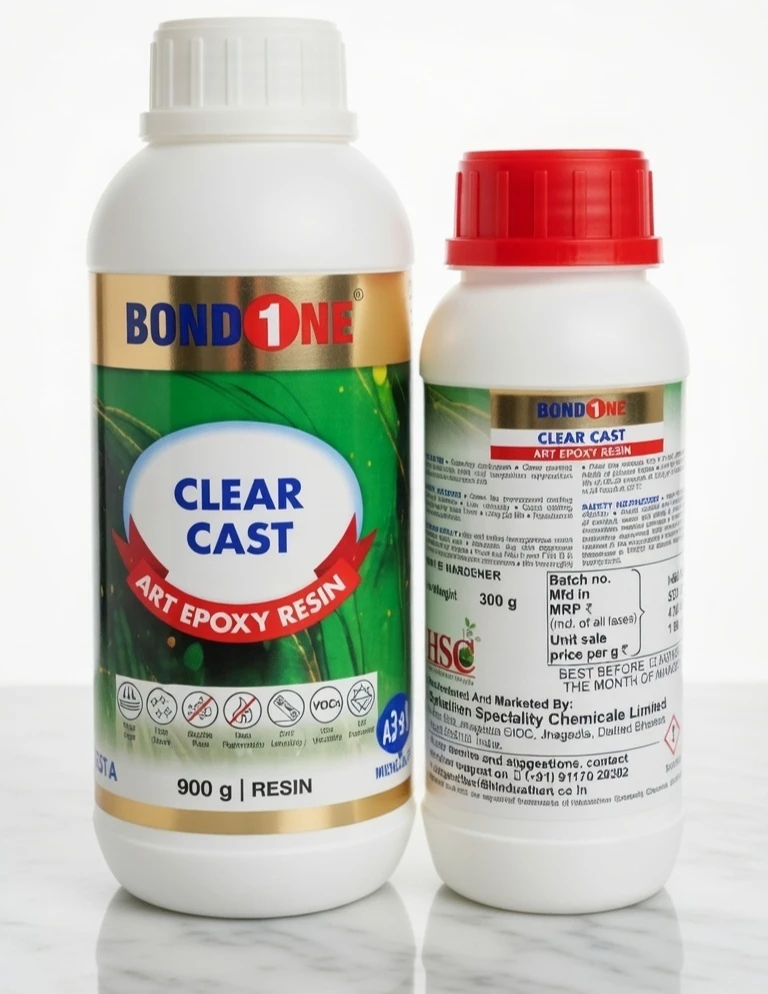
3:1 by weight for Bondone Clear Cast, 100:80 for Lapox Ultra, and 2:1 for Bondone Flowtop — there is no single universal ratio. Always measure by weight using a digital scale, never by volume. An incorrect ratio by even 5% causes a failed cure: tacky surfaces, soft spots, or complete waste of material.
Why Mix Ratio Matters
Epoxy resin cures through a precise chemical reaction between resin (part A) and hardener (part B). The manufacturer formulates each hardener to react with exactly the right amount of resin. Too much resin leaves unreacted hardener — the surface stays tacky. Too much hardener makes the epoxy brittle and can cause cracking.
In India's climate, getting the ratio right is even more critical. High temperatures accelerate the reaction — an imbalanced ratio cures poorly at 40°C and fails completely at 15°C.
Product-by-Product Mix Ratio Table
Ratios below are by weight, straight from the manufacturer TDS sheets. For pot life, cure times and seasonal planning, see the Temperature & Pot Life Charts on our technical reference.
| Product | Ratio (Resin:Hardener) | Measurement |
|---|---|---|
| Bondone Clear Cast | 3:1 | By weight |
| Bondone Clear Cast UV Stable | 3:1 | By weight |
| Bondone ClearLam CC | 2:1 | By weight |
| Bondone Flowtop | 2:1 | By weight |
| Bondone Silcrete | 100:50 | By weight |
| Jubitite Floro | 2:1 | By weight |
| Lapox Ultra | 100:80 | By weight |
| Lapox Ultra Fast | 1-part | No mixing |
| Lapox Fillo | 100:80 | By weight |
| Lapox Metalam-B | 100:50 | By weight |
| Wacker Elastosil M 4511 | 100:5 | By weight (base:catalyst) |
Mixing Ratio Calculator
Enter your total batch weight and select a product — get exact resin and hardener weights instantly.
Tare your cup between parts. Weigh resin first, tare, then add hardener to reach total.
Can I use volume cups instead of a digital scale?
No. Volume cups introduce 10-20% error because resin and hardener have different densities — a 3:1 ratio by volume is NOT the same as 3:1 by weight. Always use a digital scale accurate to 1g. A ₹500 kitchen scale saves ₹4,000+ in wasted epoxy.
Weight vs Volume — Why Digital Scales Win
Epoxy hardeners are denser than resin. When you measure 3:1 by volume cups, you actually get roughly 2.7:1 by weight — short on hardener. This is the most common cause of tacky epoxy among DIY users in India. A digital scale eliminates this error completely.
Calculation example for Bondone Clear Cast: For a 600g total mix at 3:1, measure 450g resin + 150g hardener. With volume cups, you'd likely get ~460g resin + ~140g hardener — 8% short on hardener. That 20g difference is enough to cause surface tackiness.
My ₹4,200 Mix Ratio Mistake — Learn From It
I once had a batch at 2.8:1 instead of 3:1 for Bondone Clear Cast. Looked fine at 24 hours — crystal clear, no bubbles. At 72 hours it was still tacky on top. ₹4,200 of resin gone. The hardener was short by just 20g on a 600g mix. That taught me: always use a digital scale, never volume cups, and double-check your ratio before pouring. If your epoxy isn't curing right, 9 out of 10 times it's the mix ratio.
Common Mix Ratio Mistakes
- Eyeballing the ratio — Even experienced users can't judge 3:1 by eye. Weigh it.
- Using the same cup for both parts — Residual hardener in the resin cup contaminates the batch.
- Adding extra hardener for faster cure — Creates brittle, yellowed epoxy. Follow the spec.
- Not mixing the full batch at once — Partial mixing creates uneven ratio zones.
- Forgetting to tare the scale between parts — Always zero the scale after adding resin before measuring hardener.
Does mix ratio change in Indian summer heat?
No. The mix ratio is chemically fixed by the manufacturer's formulation — never adjust it for temperature. What changes is pot life and cure speed. At 40°C, work time shrinks significantly, so pour in smaller batches or use a slow-cure product like Bondone Clear Cast instead of Flowtop.
Step-by-Step: How to Measure Epoxy Mix Ratio Correctly
- Place your mixing cup on a digital scale and tare (zero) it.
- Pour resin (Part A) to the required weight. E.g., 450g for a 600g total of Bondone Clear Cast.
- Tare the scale again. Do not move the cup.
- Pour hardener (Part B) to the remaining weight. E.g., 150g to reach 600g total.
- Stir thoroughly for 2-3 minutes, scraping the sides and bottom. A poor mix with correct ratio still fails.
- Pour immediately. Do not let the mixed epoxy sit in the cup.
What happens if I add too much hardener?
Excess hardener makes the epoxy brittle, prone to cracking, and may cause yellowing over time. The surface may cure faster but the bulk remains under-cured. In extreme cases (4:1 instead of 3:1), the epoxy may never reach full hardness and will remain rubbery.
FAQ
What is the epoxy mix ratio for Bondone Clear Cast?
Can I mix epoxy by volume instead of weight?
What is the ratio for Lapox Ultra?
Does the mix ratio change in winter?
What happens if I use the wrong mix ratio?
What scale should I use for epoxy mixing?
Can I mix epoxy without a scale if I use syringe measurements?
Why is my epoxy still sticky after 48 hours?
Does the ratio change for epoxy floor coatings?
Need help choosing the right epoxy for your project?
WhatsApp us at +91-8595955752 or browse our full product range. Buying in bulk in Delhi NCR? The Ghaziabad resin guide covers warehouse pickup and the Delhi resin guide covers same-day supply.