Epoxy Flooring India — supply & application for homes, factories, and warehouses.
As of October 2026, a complete epoxy floor runs ₹200 per sq.ft all-inclusive — material, labour, primer, and surface preparation. We supply Bondone Flowtop, Bondone Silcrete, and Jubitite Floro from our Ghaziabad warehouse and coordinate trained applicators across India, with an 8–12 year lifespan under normal use.
Estimate Your Epoxy Flooring Cost
Slide the area and pick a floor type — the total uses the same October 2026 all-in rates as our full cost guide: material + primer + labour + GST from ₹200/sq.ft (₹100/sq.ft on large projects above 10,000 sq.ft).
Above 10,000 sq.ft the calculator switches to the large-project rate (from ₹100/sq.ft). For warehouse flooring, 200kg drums are available — no bulk discounts, prices final. Need the full breakdown? See the complete cost guide →
What We Stock for Indian Flooring Projects
Three products cover every job we take — the self-levelling floor itself, a chemical-resistant primer for industrial environments, and a hygienic high-gloss topcoat for food and pharma plants.
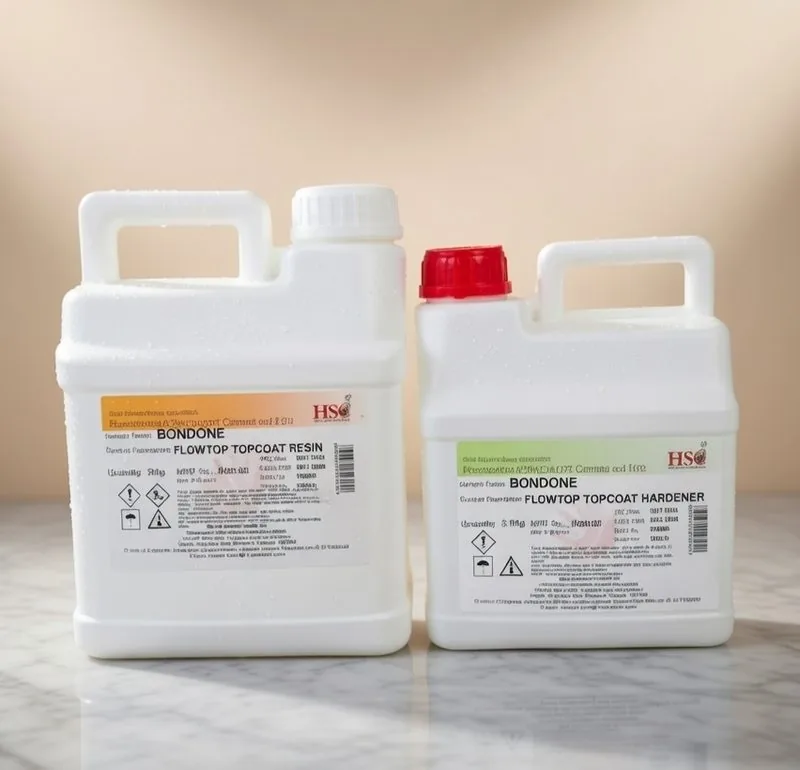
Bondone Flowtop
₹3,750The main floor for homes, warehouses, and showrooms — high-gloss, self-levelling. One 7.5 kg kit covers 45–60 sq.ft at 1mm thickness.
Bondone Silcrete
₹3,400Chemical-resistant primer and basecoat for battery rooms, pharma plants, and chemical storage — withstands 30% H₂SO₄. Never a standalone finish.
Jubitite Floro
₹3,850Hygienic, acid and alkali resistant epoxy coating for food processing plants, pharma facilities, and high-traffic areas.
All prices include GST and are valid until 31 March 2027. No bulk discounts apply.
How the Three-Layer System Works
Every Bondone flooring job is a three-layer system, not a single coat:
- Primer (Bondone Silcrete): penetrates and seals the concrete, locks down dust, and blocks damp rise — this is the layer that prevents peeling.
- Basecoat: the structural layer that builds thickness, bridges hairline cracks, and carries the main load of the floor.
- Topcoat (Bondone Flowtop): the self-levelling, UV-stable finish you walk on — gloss, colour, and stain resistance all come from this final layer.
Skimping on any one layer is the single most common cause of epoxy floor failure in India. All three layers are included in our ₹200 per square foot all-inclusive price.
Day-by-Day Install Timeline
A typical 500–1,000 sqft home install runs exactly three days:
- Day 1 — Prep: the floor is ground, any cracks filled with epoxy mortar, and the surface vacuumed until completely dust-free.
- Day 2 — Prime and pour: Silcrete primer is rolled in the morning; the Flowtop basecoat and topcoat are mixed and poured in the afternoon.
- Day 3 — Walk and cure: light foot traffic is possible after 24 hours; full cure for furniture, water, and heavy loads takes 5–7 days.
Indian homes are rarely emptied for longer than a weekend, which is why this three-day schedule — not a seven-day one — is what our customers actually experience.
How Much Does a 500 sqft Epoxy Floor Cost in India?
₹1,00,000 is the all-inclusive cost for a 500 sqft home — ₹200/sqft covering material, labour, primer, and surface preparation as of October 2026.
Residential & CitiesResidential Epoxy Flooring Across India
For Indian homes, epoxy is primarily a residential upgrade — no grout lines to clean, a waterproof surface that handles spills and mopping, and a glossy finish that makes rooms look brighter and larger.
A Bondone Flowtop residential project filmed on site — the coating going down over a prepared tile floor for a seamless, grout-free finish.
Another segment of the Bondone Flowtop project — the epoxy spread across the living area to create a single seamless, waterproof surface.
The finished Bondone Flowtop home floor — bright, seamless and grout-free, the result Indian home clients choose most.
NCR City Pages
Each city page includes a local residential project example, colony names, climate-specific application tips, and a dedicated FAQ.
NCR is our home ground — the Ghaziabad warehouse sits inside the region, so material reaches every one of the five NCR cities on the day of dispatch. Delhi apartments in Dwarka or Rohini are roughly 40–50 minutes away with a same-day cutoff; Noida and Greater Noida West are the closest, at 15–40 minutes across Sector 62/63, Phase II, and Surajpur; Gurgaon's DLF phases and Sushant Lok run 30–55 minutes; Faridabad's NIT and Ballabhgarh belt 25–45 minutes with a first-shift 7:45 AM delivery; and Ghaziabad itself is under 30 minutes or walk-in pickup at the warehouse. A single applicator team covers the full region, so installation windows are booked city by city rather than site by site.
Outside NCR, material ships PAN India in 2–5 days and an applicator travels from our Ghaziabad base — travel and stay quoted separately before you commit.
Epoxy Flooring Delhi
Apartments and homes in Dwarka, Rohini, Janakpuri and across the capital.
Epoxy Flooring Noida
Sector 62, Sector 137, Gaur City and every Expressway high-rise belt.
Epoxy Flooring Ghaziabad
Raj Nagar, Vaishali, Indirapuram and surrounding neighbourhoods.
Epoxy Flooring Gurgaon
DLF phases, Golf Course Road, Sushant Lok and New Gurgaon.
Epoxy Flooring Faridabad
Sector 21D, Sector 86, Greater Faridabad and the NIT area.
Anywhere in India
Material ships PAN India via Delhivery, Blue Dart, or surface transport — application travel is quoted by location.
For factories, workshops, and garages we supply material only, or complete application through partner applicators in your city. Industrial rates run ₹140–₹200 per square foot for standard systems and ₹220–₹350 per square foot for self-levelling epoxy mortar under heavy trucking, depending on thickness and chemical exposure. Cleaning is simple — a wet mop with mild detergent — and a light recoat every 3–5 years refreshes the gloss. There is no waxing, polishing, or sealing in the traditional sense: the epoxy itself is the finished surface.
Why Does Epoxy Flooring Last Longer Than Tiles in Indian Homes?
8–12 years lifespan with zero grout lines — tiles crack and grout stains in 3–5 years, epoxy stays seamless with just weekly damp mopping.
09Why FlowtopWhy Bondone Flowtop Is Our Top Recommendation for Indian Homes
After testing and supplying multiple epoxy formulations over 8 years, we consistently recommend Bondone Flowtop for residential epoxy flooring in India.
Self-Levelling Formula
Flows evenly across the floor without heavy manual effort — a perfectly level, self-degassed surface with fewer bubbles, even on the uneven concrete substrates common in Indian construction.
UV-Stable — Won't Yellow in Sunlight
Standard epoxy yellows within 2–3 years in direct sunlight. Flowtop resists yellowing for 8+ years — critical for south-facing rooms and large windows.
Low VOC — Safe for Occupied Homes
Families can stay in the home during installation — we seal off the work area, and the mild odour dissipates within 24 hours.
Multiple Colour Options
Clear, white, grey, beige, and custom colours. White and light grey are the most popular for Indian homes — custom colours need 7 days lead time.
Consistent Quality Across Batches
Every 7.5kg kit has the same viscosity, cure time, and gloss level — no visible lines between pours on large projects.
Three Pack Sizes
7.5kg (₹3,750), 30kg (₹13,500), and 200kg (₹78,000) kits — we match the pack size to your project, no waste, no shortage.
What We Check Before We Pour
Every Flowtop job gets the same pre-pour checklist, whether it is a 200 sqft balcony or a 20,000 sqft warehouse:
- Moisture test: a plastic sheet taped to the concrete for 48 hours — trapped condensation means the floor needs a damp seal.
- Compression check: dusty or crumbly concrete is primed twice or repaired with epoxy mortar before the system goes on.
- Temperature: we pour only between 15–35 °C, and never in direct sunlight or during the monsoon.
- Edge isolation: walls are taped so the self-levelling compound forms a clean, straight edge.
Fail any one of these and the floor will fail within a year — no matter how good the resin is. This checklist is why our residential floors carry a 3-year workmanship warranty on top of the product warranty from Bondone.
Related Guides
Deeper dives from the same Ghaziabad warehouse - every guide below uses the exact systems, prices, and application methods on this page.
Epoxy Flooring Cost
Interactive cost calculator - area, thickness, and home type to a live all-inclusive figure in seconds.
Use the cost calculator →Epoxy Application Data
Pot life, humidity failure rates, curing charts, and coverage - the technical reference for every system.
Read the application data →Bondone Flowtop
Full specs, coverage, pack sizes, and mixing for the self-levelling system most Indian homes use.
Bondone Flowtop specs →Bondone Silcrete
Chemical-resistant primer and damp sealer - where it fits in a flooring system and when to use it.
Bondone Silcrete specs →Jubitite Floro
Industrial-grade high-gloss topcoat for workshops, garages, and heavy footfall areas.
Jubitite Floro specs →Epoxy Waterproofing
When a floor job is really a waterproofing job - terrace, basement, and water tank systems.
Read the waterproofing guide →Epoxy Flooring Questions — Answered
What is the cost of epoxy flooring per square foot in India?
Epoxy flooring application costs ₹200 per square foot all-inclusive — material, labour, primer, and surface preparation as of October 2026. A 500 sqft home runs approximately ₹1,00,000 total. Material cost varies by product: Bondone Flowtop 7.5kg costs ₹3,750 incl GST.
Can epoxy flooring be installed in Indian homes?
Yes — Bondone Flowtop is the most popular choice for Indian homes. It is seamless, waterproof, stain-resistant, and requires no grout cleaning. Installation takes 2 days with minimal disruption. Light foot traffic possible after 24 hours.
How long does epoxy flooring last in India?
8–12 years for residential with normal wear. Industrial floors last 5–8 years depending on traffic and chemical exposure. Proper surface preparation is the biggest factor determining lifespan.
Do you provide epoxy flooring application across India?
Yes — PAN India service. Our trained applicator travels anywhere in India from our Ghaziabad base. Application is ₹200/sqft plus travel and stay for locations outside NCR.
What are the different types of epoxy flooring available in India?
The main types are self-levelling epoxy (Bondone Flowtop), self-levelling with chemical resistance (Bondone Silcrete as primer/basecoat), high-gloss industrial topcoat (Jubitite Floro), mortar systems for heavy-duty areas, flake epoxy for decorative finishes, and anti-static epoxy for electronics facilities.
What is the difference between Bondone Flowtop and Silcrete?
Bondone Flowtop is the self-levelling topcoat for the final seamless finish. Bondone Silcrete is a chemical-resistant primer and damp-proof basecoat used underneath Flowtop in battery rooms, chemical storage, and damp substrates. They work together — Silcrete first, then Flowtop.
How many days does epoxy flooring take to complete?
A standard home install takes 3 days — Day 1 surface preparation, Day 2 priming and pouring, Day 3 light foot traffic. Furniture and heavy loads move back in after 5–7 days of full cure. Industrial floors follow the same timeline.
Can epoxy flooring be done over existing tiles?
Yes — provided the tiles are structurally sound and fully bonded. The tile surface is ground down to create a mechanical key, primed with Bondone Silcrete, and the Flowtop system is poured on top. Loose or hollow tiles must be removed and repaired first.
Is epoxy flooring slippery?
Standard glossy epoxy is smooth, so we add anti-slip aggregates to the topcoat for bathrooms, kitchens, ramps, and factory floors. Anti-slip grades still clean easily and satisfy the friction requirements used in Indian construction.
What floor preparation is needed before epoxy application?
Concrete must be fully cured, dry, and free of dust, oil, grease, and loose material. We grind, vacuum, and moisture-test the slab before any primer goes down. Poor preparation is the number one cause of peeling and delamination in epoxy floors.
What is the cost of epoxy flooring per square foot in India?
₹200 per square foot all-inclusive — material, labour, primer, and surface preparation as of October 2026. A 500 sqft home runs approximately ₹1,00,000. Bondone Flowtop 7.5kg costs ₹3,750 incl GST, the most economical premium floor for Indian homes.
How long does an epoxy floor take to install in India?
2 days for a typical home or office floor — day one for grinding, primer, and the base coat, day two for the top coat. Light foot traffic is possible after 24 hours; full cure hardens over 7 days. Delays happen only when concrete is wet or surface prep is skipped.
Get Your Epoxy Floor Quote This Week
WhatsApp us your floor dimensions and city — a written all-inclusive quote within 24 hours.
Book on WhatsApp
Send your floor size, home or factory type, and city — get an all-inclusive quote within 24 hours.
WhatsApp JobinCompare the products
Full specs, pot life, and pricing for Flowtop, Silcrete, and Floro — nothing hidden.
Flooring Cost GuideDelivery & policies: PAN India shipping via Delhivery, Blue Dart, or surface transport from our Ghaziabad warehouse. Payment by UPI, bank transfer, or Razorpay — no COD. All prices include GST with a tax invoice for every order. No returns, exchanges, or cancellations; damaged arrivals reported within 48 hours are handled case by case.