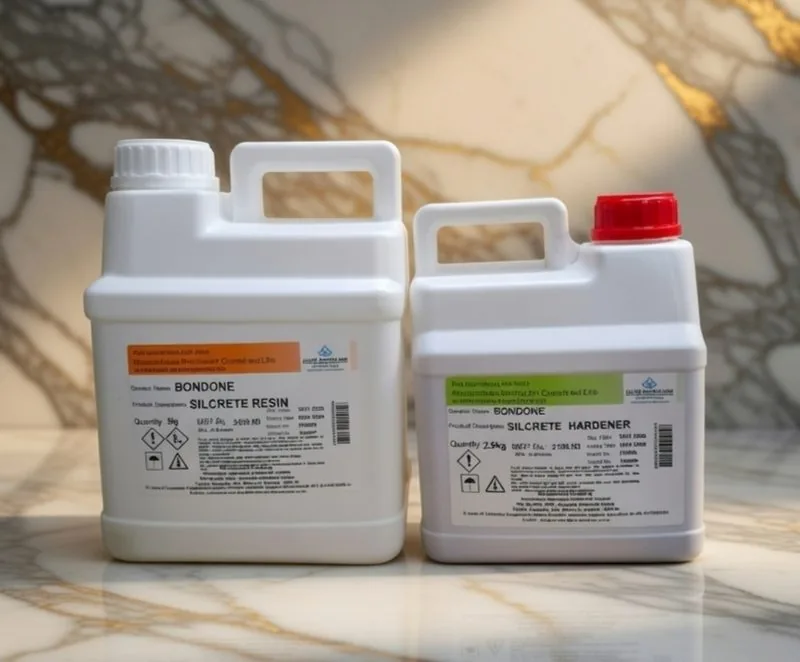
Bondone Silcrete — Industrial Epoxy Primer & Waterproofing Coat
Silcrete is the product most contractors skip and then regret. I've had three calls this year from people whose Flowtop peeled within months. Every time, the same cause — no primer. Silcrete is what goes down first. It penetrates the concrete, locks out moisture, and gives the topcoat something to hold onto. Without it, even the best epoxy floor will delaminate. Beyond flooring, I've supplied Silcrete to pharma plants in Baddi, ETP plants in Gujarat, and basement waterproofing jobs across Delhi NCR. It handles what standard coatings can't. If you're asking whether you need Silcrete — you probably do.
What Is Bondone Silcrete?
Bondone Silcrete is a two-part, solvent-free epoxy system from DCM Shriram's Bondone® range. It serves two distinct roles on industrial and commercial sites. First, as a penetrating primer that seals concrete substrates before any epoxy topcoat goes down. Second, as a standalone waterproofing and chemical-resistant coating for surfaces where protection trumps appearance. If you're a flooring contractor, a waterproofing specialist, or you manage a pharma facility, ETP plant, chemical storage area, or a building with damp basements — Silcrete belongs in your specification.
🧱 Use 1 — Flooring Primer
Applied as the base coat beneath Flowtop or any epoxy floor finish. It penetrates the concrete, blocks moisture vapour, and creates a mechanical key for the topcoat. Skipping this step is the number one cause of delamination I see on job sites.
💧 Use 2 — Waterproofing Coat
Standalone protective barrier for basements, terraces, water tanks, chemical bunds, and ETP plants. Cures to a seamless, non-porous surface that stops water ingress and resists chemical attack.
Silcrete as a Flooring Primer — The Layer No One Sees, Everyone Needs
Look, here's the thing about epoxy flooring — the topcoat gets all the credit, but the primer does all the foundational work. Concrete is porous. It breathes moisture from the ground up. If you pour a self-levelling epoxy directly onto bare concrete, two things happen: moisture pushes up and creates bubbles, and there's no mechanical bond between the epoxy and the substrate. Within months, the floor starts peeling at the edges, then the middle lifts.
Silcrete solves both problems. Mixed at a 2:1 ratio by weight, it's applied with a roller or squeegee directly onto prepared concrete. It wicks into the surface pores, seals them permanently, and leaves a slightly tacky film that the topcoat grabs onto like it's part of the same slab. On every professional flooring job I've supplied — from a 700 sqm pharma cleanroom in Baddi to a 200 sqm garage in Faridabad — Silcrete primer was applied before Bondone Flowtop went down. Zero callbacks. Zero peeling.
Coverage as primer: Approximately 8–10 sqm per kg depending on concrete porosity. For very porous or dusty substrates, a second primer coat may be needed — factor that into your estimate.
Silcrete as a Waterproofing Coat — Basements, Tanks & Bunds
When appearance isn't the priority but protection is everything, Silcrete works as a standalone coating. I've seen it applied inside overhead water tanks in Ghaziabad housing societies, across basement floors in Noida that flood every monsoon, and around chemical bund walls in Gujarat ETP facilities. It cures into a seamless, non-porous, monolithic barrier — no joints, no welds, nowhere for water or chemicals to seep through.
Silcrete resists water ingress, mild acids (including 30% H₂SO₄), alkalis (up to 40% NaOH), oils, greases, and common industrial solvents. It's not a decorative finish — the cured surface has a functional, semi-gloss appearance in a muted grey tone. For comprehensive waterproofing guidance across different substrates, see our epoxy waterproofing page.
Chemical Resistance — What Silcrete Can Handle
Honestly? This is where Silcrete earns its reputation. I keep a glass jar of 30% sulphuric acid at the warehouse with a six-month-old Silcrete sample submerged in it. No softening. No discolouration. No weight loss. I show it to every pharma and chemical plant buyer who visits — it's better than any datasheet.
Acids
Withstands 30% H₂SO₄ (sulphuric acid), 20% HCl (hydrochloric acid), and 15% CH₃COOH (acetic acid) without degradation. Not recommended for concentrated oxidizing acids above 40%.
Alkalis
Resists up to 40% NaOH (caustic soda) and 30% KOH solutions. Suitable for cleaning chemical areas where alkaline detergents are used routinely.
Solvents & Oils
Impervious to mineral oils, diesel, greases, toluene, xylene, MEK, and acetone at ambient temperatures. Shore D hardness of 80–85 after full cure.
⚠️ Lost a ₹4,800 deal once because I assumed Silcrete could handle concentrated nitric acid. It can't. Check your chemical concentration against the full TDS before ordering. I'm happy to share the datasheet — just WhatsApp me.
Silcrete vs Flowtop — What's the Difference?
I get this question at least twice a week. Contractors call asking for "the epoxy that makes floors shiny" — and they mean Flowtop. But many don't realise they need Silcrete underneath it. Here's the breakdown:
| Feature | Bondone Silcrete | Bondone Flowtop |
|---|---|---|
| Primary Role | Primer + protective waterproofing coat | Decorative self-levelling floor topcoat |
| Appearance | Functional grey, semi-gloss | High-gloss, smooth decorative finish |
| Thickness | 0.3–0.5mm (primer) / 1–2mm (coating) | 1.5–3mm self-levelling |
| Chemical Resistance | High — acids, alkalis, solvents, oils | Moderate — general industrial use |
| Best For | Pharma, ETP, basements, bunds, primer layer | Warehouses, showrooms, garages, corridors |
| Used Together? | ✅ Yes — Silcrete first, Flowtop on top. Most professional jobs need both. | |
For decorative self-levelling floors, see Bondone Flowtop. For the primer that makes it last, you're on the right page.
Technical Specifications
Mix Ratio
2:1 by weight (Resin : Hardener). Always confirm against the batch-specific TDS supplied with your order.
Pot Life
40–50 minutes at 25°C. Hotter ambient temperatures reduce pot life — plan your mixing batches accordingly.
Shore D Hardness
80–85 after 7-day full cure at 25°C. Initial walk-on hardness in 24 hours.
Pack Sizes
7.5kg, 12kg, 30kg, 200kg drum. Bulk pricing available for drums and multi-unit orders.
Coverage (Primer)
~8–10 sqm/kg on moderate-porosity concrete. Adjust for substrate condition — very porous slabs may need more.
Full Cure
7 days at 25°C for full chemical resistance. Light foot traffic after 24 hours. Vehicular traffic after 72 hours.
Price & Availability
We stock Bondone Silcrete at our Ghaziabad warehouse. PAN India delivery available — we ship to Delhi NCR within 24 hours, and to Mumbai, Bangalore, Chennai, Hyderabad, Ahmedabad, and Kolkata within 3–5 working days. COD available in select pin codes. UPI accepted.
Per kg: ₹481.33 | Bulk pricing on 30kg and 200kg drums — WhatsApp for a quote.
Frequently Asked Questions
-
1. What is Bondone Silcrete used for?
Bondone Silcrete has two primary uses. First, as an epoxy primer applied beneath floor topcoats like Flowtop — it penetrates concrete, seals the substrate, and prevents delamination. Second, as a standalone waterproofing and chemical-resistant coating for basements, terraces, water tanks, ETP plants, and chemical bunds. It's a functional protective layer, not a decorative finish.
-
2. Is Silcrete a primer or a topcoat?
Silcrete is primarily a primer — it goes underneath the topcoat. However, it can also serve as a standalone protective coating in areas where chemical resistance and waterproofing matter more than appearance. It is not a decorative topcoat. For self-levelling decorative floors, use Bondone Flowtop over a Silcrete primer layer.
-
3. Do I need Silcrete before applying Flowtop?
Yes — absolutely. Flowtop and any epoxy floor topcoat require a primer for proper adhesion. Skipping the primer is the most common cause of floor delamination. Silcrete penetrates and seals the concrete, creating a bond surface that the topcoat can grip. On every professional flooring job we supply, Silcrete goes down first. Without it, even the best topcoat will eventually peel.
-
4. Can Silcrete be used for basement waterproofing?
Yes. Silcrete cures to a seamless, non-porous barrier that prevents water ingress from damp concrete substrates. It's commonly used for basement floors and walls in Delhi NCR, where groundwater seepage is a persistent problem during monsoon. It can be applied to properly prepared concrete surfaces in basements, sumps, and underground tanks.
-
5. What chemicals does Silcrete resist?
Silcrete withstands 30% sulphuric acid (H₂SO₄), 20% hydrochloric acid (HCl), 15% acetic acid, up to 40% sodium hydroxide (NaOH), and common industrial solvents including toluene, xylene, MEK, and acetone at ambient temperatures. It also resists mineral oils, diesel, and greases. It is not suitable for concentrated oxidizing acids above 40% concentration.
-
6. What is the mix ratio of Bondone Silcrete?
The mix ratio is 2:1 by weight (Resin : Hardener). Always verify against the technical datasheet included with your specific batch, as formulations may be updated. Accurate weighing is critical — an incorrect ratio will compromise both adhesion and chemical resistance.
-
7. What is the price of Bondone Silcrete 7.5kg?
The 7.5kg kit of Bondone Silcrete is priced at ₹3,610 (₹481.33 per kg). Bulk pricing is available on 12kg, 30kg, and 200kg drum packs. Contact us on WhatsApp at +91 8595955752 for a volume quote. Prices are valid until 31 March 2027.
-
8. How is Silcrete different from Flowtop?
Silcrete is a functional epoxy primer and protective coating designed for substrate penetration, waterproofing, and chemical resistance. Flowtop is a decorative self-levelling epoxy topcoat designed for high-gloss, smooth floor finishes. Silcrete goes underneath; Flowtop goes on top. Most professional flooring installations use both — Silcrete as the primer, Flowtop as the visible finish layer.