Epoxy Resin Jewellery — crystal-clear casting at home.
Keychains, pendants, earrings, fridge magnets — all cast at home with a mould, a digital scale, and the right resin. As of October 2026, the Lapox Metalam System B 1.5 kg starter set is ₹950 incl GST from our Ghaziabad warehouse — enough for 80–100 small keychains.
Epoxy Resin Jewellery Key Facts
Which epoxy resin is best for jewellery making in India?
Lapox Metalam System B by Atul Ltd is the most widely used resin for jewellery and keychain casting in India — a 2:1 mix with a 30–40 minute pot life that demoulds in 24 hours. Bondone ClearLam CC (₹796 per 1.5 kg) is the alternative for flat lamination, coaster topcoats, and embedded-flower pieces.
How much does it cost to make one resin keychain?
8 to 12 rupees in resin, 2 to 5 rupees in findings and packaging — under 20 rupees per piece. With wholesale packs the resin cost drops to ₹5–6, while pieces sell for ₹80–200 on Instagram and Etsy India.
How long does epoxy resin take to cure for jewellery?
24 to 48 hours to demould hardness, and 5 to 7 days to full cure. Wear or stress pieces only after the full week — demoulding early gives soft pieces that distort.
Which Epoxy Resin to Use for Jewellery in India?
Not all epoxy is the same. Industrial flooring epoxy is too thick and not optically clear — you need a low-viscosity, crystal-clear casting resin designed for decorative applications.
Lapox Metalam System B
₹950The most widely used resin for jewellery and keychain casting in India. Hard, glossy, crystal-clear finish. 2:1 mix by weight, ~30–40 min pot life, demould in 24 hours.
Bondone ClearLam CC
₹796Excellent clarity for thin lamination, coaster topcoats, and shallow casting. Not ideal for deep 3D pieces, but perfect over embedded flowers, fabrics, or photos.
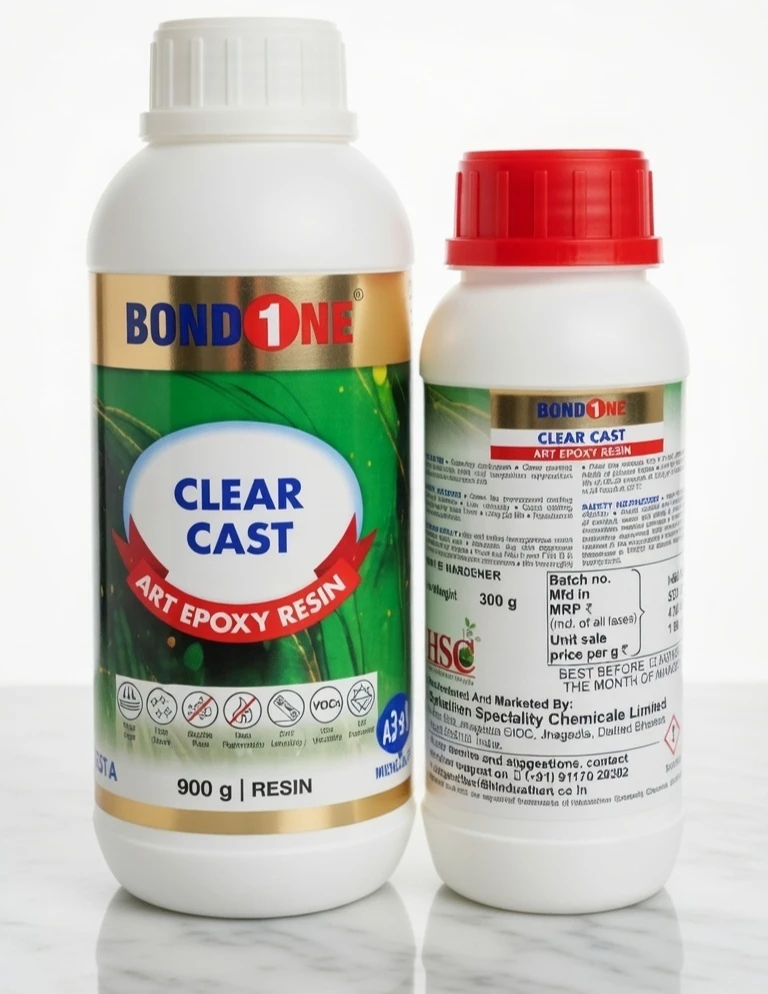
Bondone Clear Cast
₹690The beginner-friendly option for small moulds — 3:1 ratio and 300–370 minute pot life is forgiving. Best for domed pendants and shallow keychains.
How to Cast Epoxy Resin Jewellery
Five steps between you and your first finished pendant. Take your time on step two — every failed piece I've seen traces back to the mix.
Real story: Last year a customer from Noida called me at 10 PM — her resin hadn't cured after three days. Turns out she was using a kitchen scale that measures in 1g increments. For a 10g + 5g batch, that's a 10% margin of error. She's now one of my best customers — and owns a proper jewellery scale.
Prepare Your Workspace
Work on a flat, level surface. Cover with a silicone mat or cling wrap (resin doesn't stick to silicone or polyethylene). Work in low humidity — ideally below 60%. Avoid fans blowing directly over open moulds as dust settles into uncured resin.
Measure and Mix Accurately
For Lapox Metalam System B, weigh 2 parts resin to 1 part hardener by weight. For a small batch, 10 g resin + 5 g hardener fills 3–4 keychains. Stir slowly and steadily for 3–4 minutes, scraping sides and bottom. Slow mixing reduces bubble formation. The mix will look slightly cloudy while stirring — this is normal.
Add Colour and Embeds
Add pigment powder or 2–3 drops of alcohol ink after mixing. For transparent coloured pieces use very little; for opaque use more. Place embeds (flowers, foil, glitter) directly in the mould before pouring, or pour a base layer, let it gel for 3–4 hours, then place embeds and top up.
Pour and Remove Bubbles
Pour slowly from low height. Overfill slightly as resin shrinks a tiny amount. Within 5–10 minutes, pass a lit butane torch about 10 cm above the surface in a sweeping motion. Bubbles pop immediately. Repeat 2–3 times over 30 minutes. Cover moulds with a cardboard box (not plastic) during the 24–48 hour cure.
Cure and Demould
Leave undisturbed for 24–48 hours at room temperature. Flex the silicone mould gently to release pieces. Sand edges lightly with 400-grit if needed. Attach findings with super glue or drill a small hole. Full cure takes 5–7 days — avoid chemicals and scratching until then.
Safety warning: always wear nitrile gloves when handling uncured epoxy. Repeated skin contact can cause allergic reactions over time. Work in a ventilated room. Once fully cured, epoxy resin is completely inert and safe to wear.
Starting a Resin Jewellery Business in India
Resin jewellery has low startup costs and high margins. Many sellers operate purely through Instagram with 5,000–10,000 followers.
A 1.5 kg Lapox Metalam kit at ₹950 can produce 80–100 small keychains. Keychains sell for ₹80–200 each on Instagram, Etsy India, and local gifting markets. The per-piece economics, worked out honestly:
| Cost Component | Per Keychain | Notes |
|---|---|---|
| Resin (Lapox Metalam System B) | ₹8–12 | 1.5 kg set makes 80–100 keychains |
| Findings & packaging | ₹2–5 | Keyring, tags, poly pouches |
| Total material cost | < ₹20 | Wholesale packs bring it to ₹5–6 |
| Selling price | ₹80–200 | Instagram, Etsy India, gifting markets |
Prices valid until 31 March 2027. For bulk pricing on 5 kg+ resin orders, WhatsApp Jobin directly.
Ready to Start? Order Your Resin Kit
Si Epoxy Adhesives supplies Lapox Metalam System B, Bondone ClearLam CC, and Bondone Clear Cast pan-India. WhatsApp us your quantity and we'll help you pick the right starter kit. Jewellery makers in Delhi and Ghaziabad get same-day delivery — see the Delhi resin delivery guide and the Ghaziabad resin delivery guide for details.
Order your starter kit
WhatsApp Jobin directly. He will confirm stock, suggest the right resin for your first project, and arrange PAN India dispatch from Ghaziabad.
WhatsApp JobinSee the full catalogue
All products with pack sizes, mix ratios, pot life, and prices — one page, nothing hidden.
Browse All Products